Halliday’s Last O’Shea
Maurice O'Shea is the reason I became a wine writer, in a sense — I spent eight weeks in 2006 writing his story, The Wine Hunter, and came away thinking of him as the best mate I never met. This is the story of the night his memory came full circle: the night James Halliday handed me his own last bottle of an O'Shea red.
—
Lightly revised in 2026.
ONE DAY IN 2009 JAMES Halliday asked me if I’d join him for dinner. He wanted to share with me his last bottle of Maurice O’Shea shiraz. As I read the invitation it was suddenly as if many different dreams were all happening at once. The idea, simply, that James Halliday might invite me to share a treasured bottle of rare wine. But also: that this wine had been made by the hands of Maurice O’Shea himself. In the writing of the book The Wine Hunter I’d developed an affection for winemaker Maurice O’Shea that is difficult to explain. O’Shea died immediately after vintage, in 1956, a dozen years before I was born. But in the process of writing this book I’d spent months and years trying to imagine my way into Maurice’s head, and through that time my admiration and respect for him had grown ridiculously large. Maurice O’Sea, to me, was the one. He lit the flame. He refused to compromise on wine’s essential beauty when everything suggested that he should. O’Shea’s story was and is central to Australian wine but also, to the soul of wine itself.
It follows then, in a strange kind of way, that as a lover of wine and of Australian wine I’d come to think of Maurice O’Shea as the best mate I never met. He made wine, great wine, wine that could be enjoyed for decades beyond its summer in the sun. Drinking this wine was like spending time with him; like meeting him. This is what James Halliday was offering.
Those summers: on a hillside in the Hunter Valley, a long way from anywhere, O’Shea made a succession of wines that now stand as beacons of just how glorious, and age-worthy, Australian wine can be. He did this without electricity (he rode to the Peters ice-cream factory in Newcastle to gather blocks of ice so often that they gave him his own key) or even with much encouragement. He made great Australian shiraz, shiraz-pinot blends and semillon at a time when everyone was drinking, if they were drinking wine of any kind, port that had been fortified with brandy. His winery – Mount Pleasant in the Hunter Valley – never turned a profit in the whole time he was out there, which was upwards of thirty years. And yet long after he is gone the legend of his wines (at fifty, sixty, seventy and now even at eighty years-of-age) shows no sign of dying. Indeed if anything the O’Shea legend grows apace. The short summary of this journey is simple: Maurice O’Shea and his wines turned out far better than anyone thought he or they could, or should.
That is, O’Shea and his wines are a miracle.
Max Schubert, who came after O’Shea and went on to create Australia’s most famous wine, Penfolds Grange once said that he felt ‘humble in the presence’ of the O’Shea wines. ‘The wines he left behind have spoken to me on many occasions,’ Schubert said before he died, ‘not only for their all round excellence, but for their amazing longevity. [His wines] did so much to convince us who followed him that it was possible to make an internationally competitive Australian table wine.’
Which raises the question: would Penfolds Grange have ever come to be, had it not been for the inspiration of O’Shea and the beautiful wines he crafted?
The problem with the O’Shea wines now is, of course, that they’re so bloody rare. He only ever made small batches of them – during the Second World War he packaged some of his wines in recycled soft drink bottles, so limited were his resources – and when his wines were released, there wasn’t much encouragement to hold on to them. Most saw the back of a happy drinker’s throat many decades ago. In the eighteen months I spent working on this O’Shea story, I probably shared six bottles made by him; two of which transformed my perception of Australian and Hunter Valley wine. This makes me a very lucky man, though any amount is never enough and it left me craving more. Given this, the generosity of Halliday’s gesture – dinner, and his last bottle of an O’Shea red – felt as enormous as the offer of a hand to a falling man.
And besides, Halliday’s last bottle – kept in his private cellar for god knows how long – was called Mount Pleasant Mount Henry Light Dry Red 1944. That is, it wasn’t just Any Old O’Shea red wine. It was one of the wines from which the O’Shea legend has grown.
It’s generally agreed that this wine was called Mount Henry in honour of O’Shea’s best friend, Henri Renault, a French-Australian wool buyer and chef from Sydney. O’Shea’s father was Irish-Australian but his mother, Leontine Beaucher, grew up in France before travelling with her father to Australia, in search of gold. There she met and married John Augustus O’Shea in Sydney. One of their sons, Maurice, eventually created a golden history for Australian wine. The birth of fine Australian table wine therefore stems directly from a French heritage, and mother, and sensibility.
On the night we would drink this old red, Halliday carried the bottle of 1944 shiraz in his hands – keeping it upright so as not to disturb the crusty sediment at the bottom – as we sat in a small plane on route from Melbourne to the rural town of Mildura. You don’t trust bottles like this to the luggage compartment. The historic Grand Hotel at Mildura boasts an underground dining room and, in the private sitting area of Stefano’s Restaurant, it feels as though you’re sitting in a cellar. It’s not ornate. At other tables Italians argued over citrus and water and wine. It could have been 1944 in there.
Before we arrived, Chef Stefano de Pieri took a whole piglet and roasted it for four hours. When he eventually served it he said, ‘I cooked it for fifteen minutes too long.’ A perfectionist’s sad refrain. I put my fork to the meat and it melted away. Halliday went back for thirds. ‘I’ve just come back from Spain,’ he said, ‘and boy does this stack up.’ The pork proved the perfect match to the wine.
A Mildura reporter, tipped off that something special was about to happen, bustled in, ‘What would that old bottle be worth?’ The opening of some wine bottles, remarkably, is news in itself.
Halliday looked at me, as if I’m the O’Shea expert. The mantle doesn’t sit comfortably – I wish I knew so much more about him. I adore Maurice and – if it’s possible of someone you’ve never met – I miss the bugger.
‘Well,’ I said to the reporter. ‘A 1954 O’Shea red sold for about $3000 at auction a few weeks ago, including commission.’
I know this because, the day after the auction, I received the following (rather extraordinary) email from someone mid-way through reading my O’Shea biography. The email read:
I spotted a bottle of McWilliam’s Mount Pleasant Robert Hermitage 1954 in the Langton’s Melbourne auction that closed today (lot 1771). The estimate on the 1954 seemed low to me ($450–$550), so I left a bid of $950, then upped it to $1250 to be sure. I got so emotionally involved in your book The Wine Hunter that I later upped that bid to $2550.
I woke up this morning to see that it sold for $2778, and sadly not to me. My communion with O’Shea will have to wait for another chance. I know that wait might not be a short one.
‘So,’ I said to the reporter, ‘this 1944 Mount Henry might be worth $3000 to $4000?’ I looked at Halliday. I’d not convinced him.
Emphatically, Halliday interjected: ‘But the ’44 was always a much greater wine. Much greater.’
The reporter left. There were six of us at the table. Wine writer Peter Forrestal was there too; 1944 is his birth year. Halliday slid two slithers of metal down each side of the cork, and slowly extracted it in one piece; the cork would probably crumble at the hands of a corkscrew. He then lined up the glasses and poured the contents of the bottle in a single pour, across all six glasses – individual pours would cause the bottle to tip up and down, stirring the sediment. This was a 65-year-old wine, at the time. It would be easy to shake its bones loose. Careful, careful.
I thought about the wine itself: Mount Henry Light Dry Red 1944. It was made on a remote, hot, humid hill just after O’Shea’s marriage crumbled. Just before the long, lonely stretch began, the stretch that defines his winemaking life. It was sold in a flat-bottomed bottle, with no punt. There is no alcohol reading on the label and the address is listed only as Newcastle – where Mount Pleasant had offices at the time. The wine though is 100 per cent pure Hunter Valley.
Before I tasted it, I noticed that I was shaking. I’d looked forward to this moment for so long, and I was aware that once it was gone I may never have another like it. There was also a good chance, of course, that despite the wine’s worth that it would taste terrible; sixty-five years is an extraordinarily long time for any cork to hold up, let alone the wine itself. So in this moment there was all kind trepidation, excitement, fear and nerve.
And then I take a sip.
In its dotage, regardless of everything that is different in the world between then and now, it was immediately apparent that this wine was more kaleidoscopically beautiful than it was, likely, when it was young and O’Shea was still doing what he did, battling away on that hillside. As an old wine it was not simply ‘alive’, or drinkable, and therefore magical by default. Many old wines can be belittled in this way; this Mount Henry Shiraz cannot.
In April 1996, Halliday opened another bottle of this same wine. He wrote of it then:
Full brick-red; an amazingly fragrant bouquet, with layer upon layer of aromas which unfolded to reveal cedar, cigar box, dark cherry and a trace of regional earth and tar. Literally flooded the mouth with its voluptuous sweetness, silky, long and lingering, with that sweetness carrying right through the mid to back palate. The quintessence of all that is great in the Hunter Valley. Once again, there has to have been some pinot (noir) in this wine.
The late David Wynn – the modern founder of Wynns Coonawarra Estate – once said of Maurice O’Shea:‘His Mount Pleasant wines were acknowledged as the best in Australia. Not only were his wines outstandingly good, but at that stage [the 1930s] Mount Pleasant was the only top-quality wine in Australia. He established the standards for the Australian wine industry.’
The late Len Evans (who went to his grave having safely consumed his last bottles of O’Shea reds; there were never any flies on Evans) hardly disagreed. ‘Let me put it this way,’ Evans said shortly before he died, ‘I’ve had more enjoyment out of the old O’Shea wines than I have had out of old Grange – and I don’t mean anything against Grange. The O’Shea wines simply give me more drinking pleasure.’
Hunter Valley legend, the late Max Lake of Lake’s Folly fame, said more simply, ‘O’Shea did things in impossible conditions, and none of it has since been surpassed.’
On a Wednesday night, in a Mildura cellar, I lifted my glass of this beautiful old O’Shea red to my mouth. I took a second sip. It had no right to be this good – this wine was like listening to the voice of a distant generation, when things were different. I’m not kidding, this is the absolute truth: with each sip, a shiver went tumbling down my spine. My glass trembled, as did my lips. The wine was sweet and perfumed and aflame with life. It smelled of old knickers and wood palings, earth and sordid sheets. It smelled, remarkably, of sweet summer berries. It smelled of old musk lipstick and of a well-oiled baseball bat and of all manner of useless things that we are wont to treasure. Blast it, this old wine smelled short on regret and high on life – now and then and forever.
Most of us will agree on one thing. A lot of what’s said or written about wine is, at best, nonsense. As someone who makes a living from writing about wine, I stand guilty as charged; I often wonder why so many of us fuss over wine so much, why so many of us care. Surely there’s something better we could all be doing with our lives.
But then, this. An old wine by an old champion, carefully tended and resurrected. One final moment beneath the lights, after all these years. Carried and rested and resisted from opening over twenty-three thousand, seven hundred and twenty-five-odd nights. A group of eager folks. Food, lovingly prepared, spread on the table. Generosity. The mundane is frankly not bearable without this ‘extra’ of life.
And then, simply, the bottle is opened.
Its performance is beautiful, so beautiful that we all can see it, as we savour and drink it.
It makes me think that Australian wine is not just an affection, but a responsibility.
And so, safely, I can say that last Wednesday night, in an underground room, James Halliday and Maurice O’Shea unopened this responsibility, and carefully bestowed it, and then in one steady pour swung this responsibility for the wellbeing of the Australian wine that we love with an energy that felt wild and merry and given with every ounce of everything that they damn well had to give.
—
See also [The Vineyard Maurice O'Shea Planted, Reborn in the Glass]
See also [Mount Pleasant Mountain A Shiraz 2024]
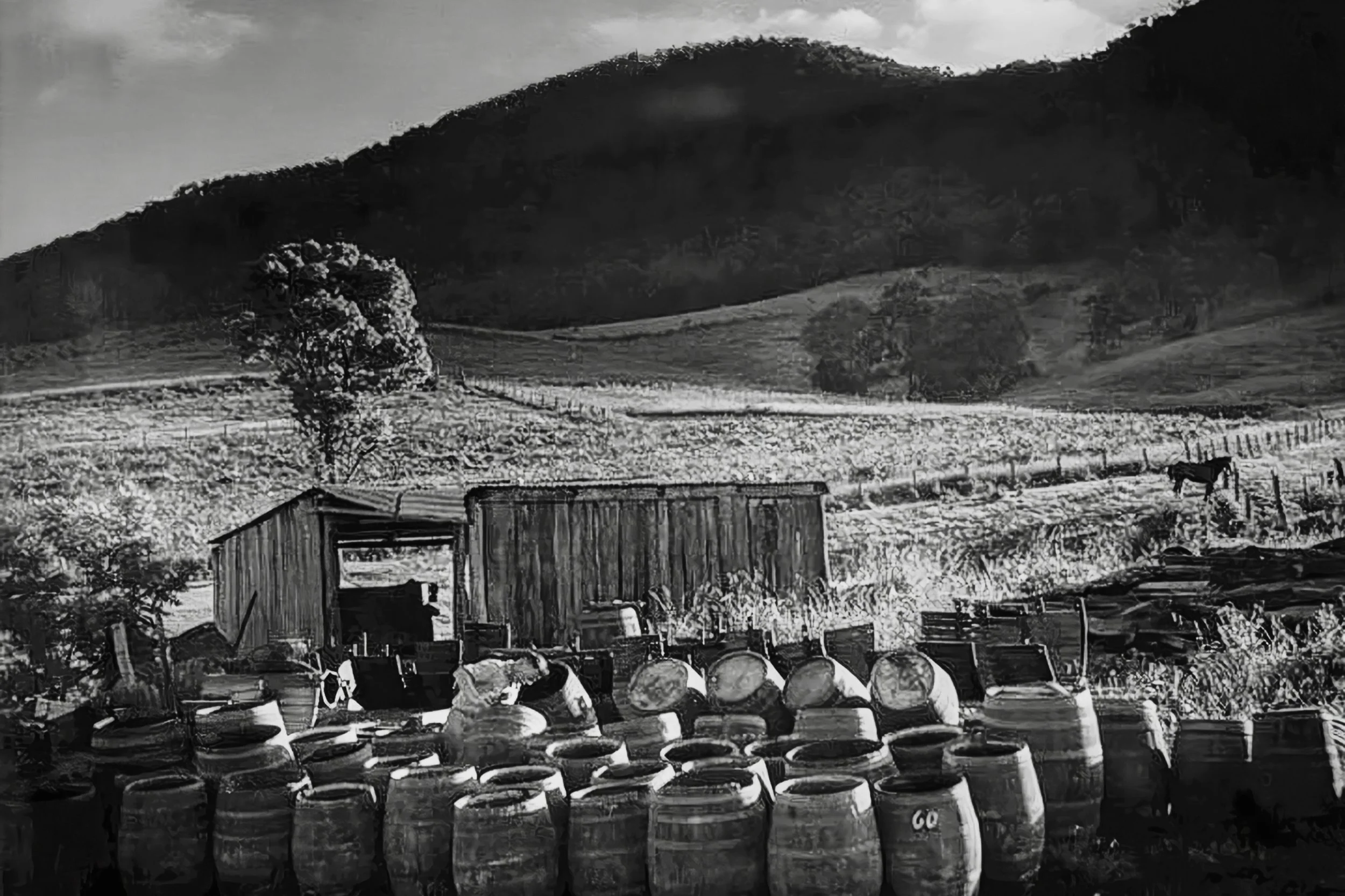
Image: Legendary winemaker Maurice O'Shea tends his barrels, in the open air, at the Mount Pleasant winery in the 1940s. Image credit: Max Dupain.