Wine That Gets You High: The Curious World of THC-Infused Wine
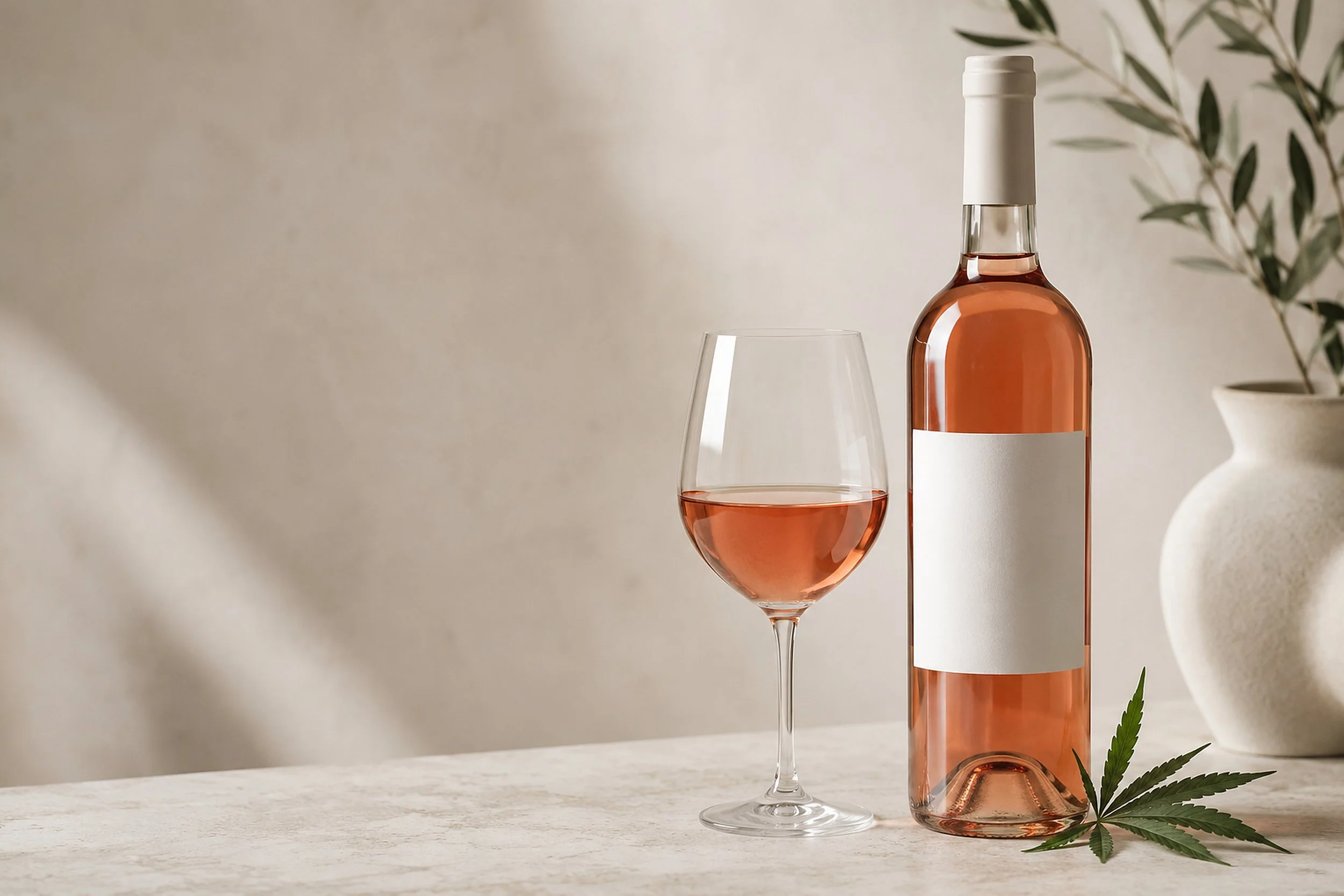
There's a new “wine” product in town — but you'll have to be quick. It doesn't get you drunk, it gets you high, and in the country where it's easiest to buy, the law is about to snatch much of it back off the shelf.
By Campbell Mattinson
You drink the wine and you don't get drunk, you get high. Faster, in fact, than if you'd eaten the drug. Welcome to non-alcoholic wine infused with THC. This is a product where worlds collide.
THC – tetrahydrocannabinol – is the main psychoactive compound in cannabis; it's the ingredient that gets you high.
To be clear: what we have here is a traditional wine, made from traditional wine grapes, that has been dealcoholised – and then had THC added, to give the non-alcoholic wine a buzz.
A confession: I have not tasted this new product category, if it can yet be called that. In fact it's not available in Australia, as it's illegal. In Australia, THC is legal only as prescribed medicinal cannabis; recreational use remains against the law. It's also worth pointing out that even in this conceptually-wild world of THC-infused wine, there is never any scope for the "wine" to include both THC and alcohol. Even in markets where both are legal, combining them in the one drink is prohibited.
I am, however, a big fan of Campari, and of a negroni; my enjoyment of whole-bunch characters in both pinot noir and shiraz/syrah borders on the certifiable; and the wine that made me fall head-over-heels in love with wine in the first place was a Yarra Valley cabernet strewn with tobacco, bay leaf and general autumnal character. So the fact that THC-infused wine – regardless of masking agents – is likely to carry a flavour profile that spends, if you'll excuse the phrase, a fair amount of time frolicking in the weeds, doesn't put me off in concept, or not in taste-profile terms.
Whether or not I'd want to drink such a product is another matter altogether, and outside of my self-revellation remit for today. But I was sufficiently fascinated by the very idea of this product that I researched the ins and outs of it, and share this research below.

So what exactly is THC-infused wine?
It's real wine, at least to begin with. It's made conventionally, from conventional wine grapes, and then the alcohol is stripped out – typically via reverse osmosis – before the THC goes in. The alcohol has to go; as noted, no legal market anywhere lets both ride in the same bottle.
What does it taste like?
Lighter than the real thing, by most accounts, and at times closer to a grown-up sparkling grape juice – dealcoholisation takes body and warmth with it. But the aromas, the tannin, the general architecture of wine remain. You drink it from a wine glass and it behaves, more or less, like wine.
How high does it get you?
Not very, by design. Most products deliver between 2.5mg and 10mg of THC per serve – a social buzz rather than an event. California's Bloom & Barrel runs at 4mg per glass; Rebel Coast, the outfit that launched the world's first legal cannabis-infused, alcohol-removed wine, puts 16mg in a bottle of its dealcoholised Sauvignon Blanc.
Why does it hit faster than an edible?
Most of these wines use water-soluble or nanoemulsified THC, which absorbs through the mouth and stomach lining rather than waiting on digestion. Effects arrive in roughly 15 minutes, against the hour-plus of a brownie. Hence: you get high faster drinking the drug than eating it.
Where can you buy it?
In short, as of July 2026: North America, and almost nowhere else. In the USA, marijuana-derived THC wines are sold through dispensaries in recreational-cannabis states – California, Colorado, Illinois, Michigan, Nevada, New York, Oregon, Washington among them. A handful of states, notably Minnesota and Wisconsin, have allowed low-dose hemp-derived THC drinks to be sold in ordinary liquor stores and bars.
Canada allows THC-infused wine alternatives nationwide, distributed through provincial cannabis stores. In Europe, CBD-infused wines are legal and common, but THC versions remain illegal everywhere, including in Germany, Luxembourg and Malta, where cannabis reform hasn't yet built retail infrastructure for products like these. And in Australia and New Zealand: no, not now, and on current settings, not bloomin’ likely.
The regulatory rug-pull: November 12, 2026
One critical caveat to all of the above. US federal law passed in November 2025 will effectively ban intoxicating hemp-derived THC products (US) nationwide from November 12, 2026, capping them at a negligible 0.4mg of THC per container. The dispensary system – the marijuana-derived side of the market – is untouched. But the mainstream-retail experiment, the version where you pick up a THC wine alongside your groceries, looks close to over. If the category has a future in the US, it looks likely to live behind the dispensary counter.
So, if you’re in an appropriate US State and you want to give it a, err, crack; pipe up and act fast. Not that I am endorsing any of this. I’m just a wine journo.
THC-infused wine: quick answers
Is THC-infused wine alcoholic? No. The wine is fully dealcoholised before THC is added; no legal market permits alcohol and THC in the same drink.
How much THC is in cannabis wine? Typically 2.5mg to 10mg per serve – designed for a mild social buzz, not a strong high.
How quickly does THC wine take effect? Around 15 minutes, thanks to nanoemulsified THC – much faster than conventional edibles.
Is THC wine legal in Australia? No. As of July 2026, THC is legal in Australia only as prescribed medicinal cannabis; recreational THC products cannot be sold.
Where is THC wine sold? Licensed dispensaries in legal US states and provincial cannabis stores in Canada – with US hemp-derived retail sales set to end in November 2026.
—
Footnote: I was walking around my local supermarket, ingesting the news of David Bicknell ["You never know you're going to get boned until you do": Bicknell out at Oakridge] when somehow or other this THC-infused wine concept entered my mind. For a split-second I wondered whether the concept of this strange wine product, and the people responsible for the Bicknell decision, were somehow linked, such was the weirdness of the world as it seemed right then. Of course they’re not. But some days and some news items do make the world seem more bizarro than others.