A wine journey into the straits of Majella Wines
This article was first published in 2003. Times have changed but this article is still as interesting today as it was then.
—-
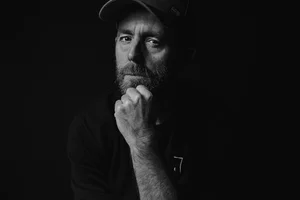
BRIAN LYNN of the Majella winery in Coonawarra is not on fire. There’s smoke though, real smoke, coming out from under the doors. Sparks flying. Alarms ringing. ‘She’s smokin’ and she’s rattlin’, Lyn – known as The Prof – says as he unlocks the front door. ‘The fire brigade’s ringing. Bruce’s (winemaker Bruce Gregory) computer’s down. Mine’s down. We’ve got meltdown,’ he says. Running.
‘Computers …’ I say.
‘Oh, this is worse. The whole thing …’ and he’s on the phone. As he unplugs his printer. The computer. Taps a few keys. Moves some paper. Notices the fax I’ve sent him.
‘This you?
I nod. ‘Never heard of you,’ he says.
He rolls on. ‘I go to wine dinners and wine tastings and there are a lot of people who take wine too seriously. All they want to do is talk or write about wine – sometimes I look at them and think: all wine is, is fermented grape juice flavoured with oak. It’s not rocket science.’
Then, because it’s his favourite line right now, and despite the fact that the alarms are still clanging and that there’s still the strong smell of smoke, he adds: ‘There’s more to life than wine. There’s poetry to read. Food to eat. Women to love.’
‘Poetry?’
The Prof stops. ‘Well, I don’t get to read much poetry.’
‘No one does,’ I say – then ask him how it is that Majella, who has been growing grapes (but selling most of them) in Coonawarra since 1968, has gone from being a brand new label in 1991 to, arguably, one of the most anticipated annual cabernet releases on the Coonawarra/Australian wine calendar – or certainly the one which engenders the most loyalty. In the wine shops and wine forums, at wine dinners and wine clubs, there are times when it feels like Majella mania out there. Rarely a negative word is spoken. Smoking? Alarms? Somebody check the fax machine – these guys are on their own kind of fire.
‘Our success is simple: we’re bloody good grape growers. We’ve got a very nice patch of dirt. We’ve spent 30 years learning how to grow the grapes and get them right. And if you talk to the French, they’ll tell you that’s 90 percent of what it’s all about. Great grapes. Sympathetic winemaking. That’s all we do. She ain’t hard!’
The sympathetic winemaking is done by Bruce Gregory, a bloke who’d called me a few days earlier. ‘I’ll get the Prof to spend some time with you. He does all the marketing – I’m just a simple winemaker,’ he said.
‘I’m just a simple journalist,’ I replied.
Bruce Gregory, as a winemaker, is self-taught – which partly explains why he’s so good. He’s self-fired. He’s one of these quiet-achieving types who likes to quietly stick it up the qualified winemakers – and knock their wines off at Wine Shows. I know this because I’ve tasted the wines – and also because the Prof told me.
‘Bruce’s never told me in so many words, but I get the impression that once or twice someone might’ve used words to the effect of ‘what would you know, you’re not even qualified’. That’d get Bruce going. He’s one of our great assets.’ He looks at his watch.‘Fancy a coffee?
‘Sure.’
We walk out of his office and through the cellar door area where, ominously, there’s an organ. I’ve heard, from other sources, that the Prof can crank out a fair racket on that thing, and as it’s still early and my head hurts from the night before, I don’t fancy the shrill. Thankfully, suddenly, we’re in the tea room – and who knows where they all materialised from, but there’s suddenly a chorus of people here. Kids. Babies. Workers. Wives. Brothers. Sons and daughters, husbands and friends. Cakes. A proper coffee machine. People filling out footy tip forms. The whole kit-out of local congeniality.
The Prof pours me a coffee. It’s not bad. ‘Word’s out that we do a fair morning tea here,’ he says, surveying.
I finish my coffee and rinse my cup, and the Prof takes it and wipes it meticulously. Later, before he leaves me to taste through a line-up of wines in the Majella ‘boardroom’ – which has a kitchenette-styled stainless steel sink-bench attached – he pours a wine and spills a drop, and quickly hunts out a tea-towel and gives the bench a thorough wiping. When you walk out into the winery itself, which is maybe five years old but looks brand-spanking, he comments on its cleanliness, its tidiness – which it is. Most wineries these days seem clean, but this is exceptionally so. ‘Bruce is of the belief that wine is a food, and should be made in a food factory to food cleanliness/hygiene standards,’ the Prof says. He then points at a cluster of fermentation tanks, the type usually referred to in Australia as a Tank Farm. In this cluster there are only a few – and there’s a sign on them: Hobby Farm. ‘There are more tanks out the back which I’m calling the Stud Farm,’ he says. ‘Sign’s not up yet.’
We get back to the Prof ’s office. We talk food – he’s a curry freak, various exotic types, high salt and high sugar – and discuss the amount of time he spends answering the same questions over and over. ‘Everyone asks when was our first vintage. When were the vines planted. What do you age them in etcetera etcetera. The same questions all the time. No one ever asks the interesting things, like where did we get our capsules or where do we get our bottles from – which we import from Italy.’
Smiling. ‘So where do you get your bottles from …?’
‘We wanted something special for the Malleea (Majella’s top-priced wine, and cabernet-shiraz). We saw it in a bottle showroom and …’
‘There are bottle showrooms?’ I have an image of a glass showroom floating down a river of wine, a la Peter Carey’s Oscar & Lucinda.
‘Of course there are,’ he says. ‘Just like there are yeast catalogues – there are bottle showrooms.’
‘There are yeast catalogues?’ I’m starting to finish each sentence with an exclamation.
‘Yeasts for stuck ferments. Yeasts for chardonnay. Yeasts for cool ferments or warm ferments …’
We move into the boardroom. He leaves me alone to taste the new Majella wine releases – they’re a lovely collection. They taste of pure, dark cabernet fruit, flavoured with oak – just like the Prof said they would. They also taste smooth and slippery on the tongue – drinking them would be like kissing a baby’s neck, except that the wine is a whole lot more flavoursome, and lip-staining, than that. In short, they’re the kind of wines you can take anywhere: for casual drinking, or to impress.
I tell him so. ‘We’re proud of them. Real Coonawarra wines,’ he says.
Then he gets going. ‘I remember going to a tasting of Wynns Coonawarra cabernet going back 40 years. They were in flights of six, and apart from a flight from the early 70s …’
‘When was this tasting?’
‘Probably nine or ten years ago.’
‘Okay.’
‘There was such a distinctive character, a distinctive style to them all. They all belonged to the same family of wines. That’s what we want to create with Majella. We’ve worked at the style and we’re not going to tamper with it. Same great fruit, same great handling, same style year-in year-out – we see no reason to change the label or anything.
‘People are confused about a lot of wines out there. I don’t want any confusion with Majella. I want people to be able to stick their nose in a glass and go: it smells like a Majella.’
Majella Wines have about 60 hectares of grape vines on the eastern side of Coonawarra, all of it on classic terra rossa soil. The Prof Brian Lynn and his brother Tony now have access to most of their grapes: famously, the Lynn’s are long-time suppliers to Wynns, which is part of how the Majella legend spread so fast in the first place … word got out that Majella grapes had been used in the elite Wynns John Riddoch label for years. In 2001, contracts to supply fruit to Wynns finally expired, which meant that production, which was as little as 600 bottles of Majella shiraz for the 1991 release, is now headed for between 7500 and 13,000 dozen, depending on the year. The range is simple: cabernet, shiraz, blends of the two and a riesling. The Lynn family has been in Penola/Coonawarra area for the past 100 years; a Lynn ancestor was educated by Mary MacKillop.
It’s not just history – to the Lynns, Coonawarra is personal. They live here, work here, farm here, make it famous. They die here too – tragically, a couple of years back, one the Prof ’s sons, Matthew, was killed as the result of a hit-run car accident. He died in hospital two weeks later. The night I heard this I was among a large group of wine folk, and the function went sullen – the Lynns are loved beyond all boundaries. If drinking the luxurious Majella wines makes you happy then it’s not just the grapes: it’s the people who made them. These are good folk, good to be around, life-givers. Majella’s wines are the type that you want to be generous with, because they are being generous with you.
Not that it’s easy making wine in Coonawarra today. It’s a region with an image problem. There is a widespread perception that Margaret River has wrestled away the mantle as Australia’s top cabernet region. There is also a perception that Coonawarra has sat on its hands and let it happen. I use the word ‘widespread’ deliberately: most weeks I hear someone say that Coonawarra is not what it could be, not what it was, not what it should be. Brian Lynn, born and bred and doing the region proud, hears it too – and it makes him mad.
‘I get very annoyed when some critic breezes into the place for only a few hours,’ the Prof says, ‘and then pontificates at length on the viticultural practices of the district. I’ve spent all my working life in the grape growing industry here in Coonawarra – I hope that gives me some credibility.
‘Before anyone gets too critical of Coonawarra wines – and I still insist that they are the best value for money wines in the country – let them come here and live and work for a few weeks. I for one don't criticize the practices of other regions – I know how hard it is to consistently grow great grapes – but I do get annoyed at the uninformed criticism of Coonawarra.
‘As to our wonderful Coonawarra soil, what do you suggest we do? Most of us never plough it or knock it around in any way. We rarely add fertilizers (artificial or otherwise). We restrict our herbicide use to a bare minimum. We very rarely use insecticides. We just leave it alone and let it do what it does best – punch great flavour into grapes to give us the type of wine for which we are famous. It may not look pretty to see a few weeds growing here and there. It may not make great pictures in a coffee table book. It does though, grow great grape vines.
‘There is another point to remember: Coonawarra used to be quite a small vineyard region that grew quite exceptional grapes. Thanks to a boundary dispute (over the official area allowed to be called ‘Coonawarra’) Coonawarra is now far bigger than a lot of us think it should be, and I’m not convinced that it all grows quality grapes. There are many of us that fought tooth and nail to keep the boundaries smaller. It cost us dearly in time, energy and money. We lost – the wine world is poorer for that!’
This is important stuff – it’s important to let Prof Lynn roll with it. Prof Lynn: ‘We moved in to mechanical harvesting in the late 1970s, and then to mechanical pruning in the early 1980s. I know it’s an anathema to the purist who believes that the ‘perceived’ old ways are the only way to go – that if it’s not done slowly and by hand then the wine is not up to scratch. Believe me, we have done many, many trials of hand picking/pruning as against the mechanical methods, and if there were any discernable differences we would change. There isn’t!’
Brian Lynn then mentioned an interesting fact – that the grape yields at Majella haven’t changed much since 1971, steady at 3.1 tonnes per acre. Taste any Majella cabernet from the past ten seasons, and it would be difficult to suggest that this was anything other than a balanced, even crop. Grape growing, like most of the best things in life, is not a race. It is not best done by numbers. If you grow too heavy a crop on a vineyard, 99 times out of 100 it will not make for as good a wine as a balanced moderate crop – but there is a limit to this. The smallest tonnage per acre does not necessarily make for the best wine. Majella, the wine and the people, know this instinctively. It’s why their wine tastes so good – but also why their morning tea is packed with people. They’re balanced people making balanced wines.
I hardly remember leaving Majella that morning – but then, that makes sense too. A journey through the straits of Majella’s wines leaves a single, lasting, impression: there’s something human about the place; something vital; something both flawed and perfect, musical and dramatic – something like home.